
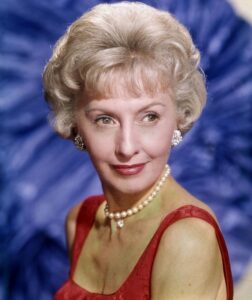
 Born Ruby Stevens in Brooklyn, N.Y. on July 16, 1907, Barbara Stanwyc was the fifth and youngest child of a working-class couple. When she was four, Ruby’s mother was pushed off a moving streetcar by a drunken stranger and died. Two weeks later her father joined a crew digging the Panama Canal and was never heard from again. She and her brother Byron were cared for by her sister Mildred, just five years her senior. When Mildred became a showgirl, Ruby and Byron were sent to a series of foster homes, sometimes four a year from which Ruby often ran away.
During the summers of 1916 and 1917 Ruby toured with Mildred, practicing her routines backstage. At 14 she quit school to work in a department store. By 16 she had become a chorus girl. On Broadway by 1926 as Barbara Stanwyck, she made her first film in an uncredited role in 1927’s Broadway Nights. She was engaged to actor Rex Cherryman when he became ill and died at the age of 31 in 1928. Reeling from the loss, she married Cherryman’s best friend, actor and comedian Frank Fay later that year.
Now a star, Stanwyck made two unsuccessful talkies in 1929, but her work in The Locked Door impressed director Frank Capra who cast her in 1930’s Ladies of Leisure and later The Miracle Woman and The Bitter Tea of General Yen with her, all of which were successful as were all Stanwyck’s films of the era.
Stanwyck’s tempestuous marriage to Fay ended when the drunken Fay threw their three-year-old adopted son into a swimming pool in 1935. She later married second husband, matinee idol Robert Taylor in 1939. That marriage ended in 1952.
Stanwyck received her first Oscar nomination for the 1937 version of the perennial tearjerker Stella Dallas, followed by memorable performances in such films as 1939’s Golden Boy which made a star of William Holden and 1940’s Remember the Night opposite Fred MacMurray.
1941 provided her with three of her best-remembered roles. She starred opposite Henry Fonda in Preston Sturges’ The Lady Eve, and Gary Cooper in both Frank Capra’s Meet John Doe and Howard Hawks’ Ball of Fire, for which she received her second Oscar nomination. She received her third Oscar nomination for that year’s Double Indemnity again playing opposite Fred MacMurray.
1945’s Christmas in Connecticut opposite Dennis Morgan provided with again great comic role. The 1948 thriller Sorry, Wrong Number earned her a fourth Oscar nomination.
She had one of her last major starring roles in Douglas Sirk’s 1953 tearjerker All I Desire opposite Richard Carlson and her first supporting role in 1954’s Executive Suite.
With her screen career dwindling, Stanwyck made a successful transition to TV in 1958, winning an Emmy for 1960’s The Barbara Stanwyck Show. She reached her apex with the long-running series, The Big Valley in which she starred from 1965 to 1969, winning a second Emmy in 1966 and additional nominations in 1968 and 1969.
She finally received an honorary honorary Oscar at the 1981 Academy Awards, which led to her co-starring role in the 1983 mini-series, The Thorn Birds, for which she won yet another Emmy for her magnificent performance.
Barbara Stanwyck died January 20, 1990 of congestive heart failure, chronic lung disease and emphysema at the age of 82.
ESSENTIAL FILMS
STELLA DALLAS (1937), directed by King Vidor
A 1923 novel, a 1924 play and a famous 1925 silent film with Belle Bennett preceded it and a long-running radio series from 1937 to 1955 succeeded it, as did a 1990 remake with Bette Midler, but this is the version of the venerable tearjerker most people are familiar with thanks mainly to Stanwyck’s portrayal of the small town gal who marries above her station and lives to regret it. Essentially a tale of mother love, Stanwyck’s Stella does all she can for her daughter (a radiant Anne Shirley) before realizing what’s best for the girl is turning her over to her ex-husband and his cultured new wife earning Stanwyck her first Oscar nomination.
BALL OF FIRE (1941), directed by Howard Hawks
Her third major comedy this year, preceded by The Lady Eve and Meet John Doe, finds Stanwyck and Cooper in this screwball comedy based on Snow White and the Seven Dwarfs. Stanwyck plays a chanteuse who helps young professor Cooper and seven elderly profs write a modern slang dictionary while on the lam from her gangster boyfriend. The jokes fly fast and furious with the superb support of Oscar Homolka, Henry Travers, S.Z. Sakall, Tully Marshall, Leonid Kinsky, Richard Haydn and Aubrey Mather adding just the right amount of eccentric flourish to the merriment. It eared Stanwyck her second Oscar nomination.
DOUBLE INDEMNITY (1944), directed by Billy Wilder
Stanwyck played her share of wicked women, but none more cold-hearted than seductress and murderess Phyllis Dietrichson in Wilder’s film of James M. Cain’s novel, scripted by Wilder and Raymond Chandler. Stanwyck’s hideous blonde wig is just about the only bad thing anyone has ever had to say about the film. The performances of Stanwyck, Fred MacMurray as the insurance salesman she talks into murdering her husband, and Edward G. Robinson as the intrepid insurance investor who isn’t fooled by MacMurray’s deception, turn in flawless performances with Stanwyck earning her third Oscar nomination for it.
EXECUTIVE SUITE (1954), directed by Robert Wise
MGM’s glossy all-star expose of a corporate boardroom in turmoil provided strong characterizations for such stars as William Holden, June Allyson, Fredric March, Walter Pidgeon, Shelley Winters, Paul Douglas, Louis Calhern, Dean Jagger and Nina Foch, but it is third-billed Stanwyck, whose on-screen role is minimal but key to the drama, whose performance is best recalled by audiences years after they’ve seen it. It’s her vote that’s pivotal in deciding whether forward thinking Holden or loyal company ma March will become president of the company following Calhern’s sudden death.
THE THORN BIRDS (1983), directed by Daryl Duke
The mini-series from Colleen McCullogh’s sprawling novel covers sixty years in the life of an Australian family. The principal roles are played by Richard Chamberlain, Rachel Ward and Bryan Brown with memorable supporting turns from Jean Simmons, Richard Kiley, Christopher Plummer, Piper Laurie, Mare Winningham, Philip Anglim and others. No one, however, could top Stanwyck’s lusty portrayal of landowner Mary Carson, who at 75, attempts to seduce Chamberlain’s young priest. Stanwyck’s great comeback performance won her a Golden Globe for Best Supporting Actress and an Emmy for Best Lead Actress.
BARBARA STANWYCK AND OSCAR
Stella Dallas (1937) Nominated – Best Actress
Ball of Fire (1941) Nominated – Best Actress
Double Indemnity (1944) Nominated – Best Actress
Sorry, Wrong Number (1948) Nominated – Best Actress
Honorary Award (1981) – Oscar – For her superlative creativity and unique contribution to the art of screen acting.