

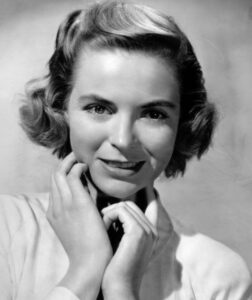
 Born June 14, 1918 in Omaha, Nebraska, Dorothy McGuire was one of three actresses who came to prominence in the original Broadway production of Thornton Wilder’s Our Town. Both she and Teresa Wright had been original star Martha Scott’s understudy, with McGuire eventually replacing Scott when she went to Hollywood. Several Broadway roles later, she was herself brought to Hollywood by David O. Selznick to recreate her Broadway role of the child bride in 1943’s Claudia. Within two years she was playing her first mother role in Elia Kazan’s A Tree Grows in Brooklyn. That same year she was reunited with her Claudia co-star, Robert Young in the romantic drama, The Enchanted Cottage, and rejoined him for 1946’s Claudia and David, the sequel to their first film together.
Two other 1946 films, The Spiral Staircase, in which she played a mute servant in distress and Till the End of Time, in which she played a war widow, brought her further acclaim, but still no awards recognition.
Finally, her portrayal of Gregory Peck’s fiancé in 1947’s Gentleman’s Agreement brought her an Oscar nomination. Although it was hardly her most distinguished performance, it was an important film and the nomination helped make up for the slight of the previous few years. Real stardom, though, still eluded her and she returned to the stage for several years. Back in Hollywood in 1950, her film roles were mostly fluff. Even 1954’s Three Coins in the Fountain, a huge box-office success, did not bolster her personal popularity. The film was most admired for its Oscar winning cinematography and title song.
Her Quaker mother in 1956’s Friendly Persuasion finally provided her with a role for the first time in years that was both critically and commercially lauded. She started out awards season with a bang, winning the National Board of Review’s award for Best Actress, but, alas, Oscar passed her by once again.
Hollywood wanted her, but they wanted her only in mother roles now. Disney’s Old YellerSwiss Family Robinson and Summer Magic were all big hits and even the kids knew who she was now, but dramatically these roles hardly tapped into her enormous strengths as an actress. Within that period, though, she gave three performances that remain a testament to those strengths.
Playing against type as a bitter, crippled woman, she easily stole 1959’s This Earth Is Mine from Rock Hudson and Jean Simmons and playing a woman trapped in a marriage to a cruel alcoholic, she added class and distinction to the seminal late 1950s tearjerker, A Summer Place. Starring opposite Robert Preston, she had her last great screen role as the wife and mother in 1960’s The Dark at the Top of the Stairs.
One would think that at least one of these last three roles would have gotten her a long overdue second Oscar nomination, but it wasn’t to be.
She played the mother all mother roles, the Virgin Mary, in George Stevens’ generally dismissed 1965 epic, The Greatest Story Ever Told. Twelve years later she received an Emmy nomination playing Nick Nolte and Peter Strauss’s mother in Rich Man, Poor Man. The year after that she was Marmee in a well-received TV version of Little Women. In occasional TV roles for a little over a decade after that, she played her last in 1990.
Dorothy McGuire died in 2001 at the age of 85. The failure of the Academy to include her in the In Memoriam segment at the 2002 Oscars caused a major uproar. Claiming they only had room for so many recently deceased Academy members in the segment, the Academy made no apology and admitted no error. The segment has been looked upon with scorn ever since.
ESSENTIAL FILMS
A TREE GROWS IN BROOKLYN (1945), directed by John Cromwell
McGuire was only 27 when she played the stern mother in Kazan’s film version of Betty Smith’s beloved novel about life in the Brooklyn tenements in the early part of the 20th Century. She is very effective as are Joan Blondell as her brassy sister, James Dunn in Oscar winning portrayal of her alcoholic piano playing husband, Lloyd Nolan as a sympathetic policeman, James Gleason as Dunn’s employer and Butch Jenkins as McGuire and Dunn’s rascally son. The film’s best performance, however, was provided by Peggy Ann Garner as McGuire and Dunn’s daughter, the tree growing up in Brooklyn for which she won an honorary juvenile Oscar.
TILL THE END OF TIME (1946), directed by Edward Dymtryk
Released three months before The Best Years of Our Lives, this tale of three homecoming marines suffered in comparison to its better-known counterpart, but in its way is just as moving and affecting. The film is from a novel by Niven Busch follows the three traumatized veterans, played by Guy Madison, Robert Mitchum and Bill Williams. McGuire plays an older woman; a war widow that Madison easily picks up in a bar. Part girlfriend, part surrogate mother, she helps him through his readjustment to civilian life in one of her most acclaimed performances. She received her only scar nomination for the following year’s Gentleman’s Agreement.
INVITATION (1952), directed by Gottfried Rheinhardt
In the nine-year period between Gentleman’s Agreement and Friendly Persuasion, McGuire’s talents were mostly wasted on film, but not here. Though she is second billed to Van Johnson, she is very much the centerpiece of this romantic drama in which she plays the plain but pampered daughter of wealthy Louis Calhern who pays Johnson to marry her and along with Johnson and her doctor, Ray Collins, conspires to keep from her the secret that she is slowly dying. The actors, especially McGuire, keep this unusual film from dissolving into a tearjerker. McGuire is heart wrenching in the denouement and unforgettable in the film’s closing moments.
THIS EARTH IS MINE (1959), directed by Henry King
A beautifully photographed film set in California’s Napa Valley, this soap opera stars Rock Hudson as the illegitimate grandson of wealthy wine grower Claude Rains. Jean Simmons, the daughter of one of Rains’ sons, is brought over from England and is attracted to Hudson who could have been a kissing cousin except that his mother, Anna Lee, the wife of Rains’ other son, conceived him with Rains’ daughter’s husband, Kent Smith. McGuire plays the bitter, wheelchair bound daughter in one of her most unusual roles. Even when playing a mean character, she could still break your heart with a look or turn of phrase as she does here.
THE DARK AT THE TOP OF THE STAIRS (1960), directed by Delbert Mann
Robert Preston is a bit too bombastic as the traveling salesman with a wandering eye, but he does grow on you. No need for the rest of the cast to grow on you. They’re all great from the get-go, especially McGuire as his long-suffering wife, Eve Arden as McGuire’s bigoted sister, Angela Lansbury as Preston’s sometimes mistress, Shirley Knight as Preston’s daughter, Lee Kinsolving as the daughter’s beau and Richard Eyer as Preston’s son who fears the dark at the top of the stairs. The title, of course, has another meaning, the lack of sex between Preston and McGuire, which it is rather frank about in a way quite unusual for the Production Code era.
Dorothy McGuire and Oscar
Gentleman’s Agreement (Best Actress nominee) – 1947