
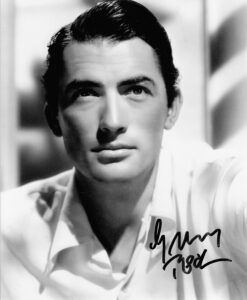
 Born April 5, 1916 in La Jolla, California, (Eldred) Gregory Peck was raised by his grandmother after his parents divorced when he was five. Sent to a Catholic military school by his father, after the death of his grandmother, he later enrolled as a pre-med student at U.C.-Berkeley but caught the acting bug. After graduation he moved to New York to study at the Actors Playhouse. Often broke, he would sometimes sleep on a bench in Central Park. He worked at the 1939 World’s Fair and as a tour guide for NBC.
Peck finally got his big break on Broadway in 1942 as the star of Emlyn Williams’ The Morning Star, followed by another play, The Willow and I. Hollywood beckoned and he made his screen debut in Jacques Tourneur’s Days of Glory, released in 1944.
It was his next film that made him a star playing Francis Chisholm, the missionary priest in Henry King’s film of A.J. Cronin’s The Keys of the Kingdom. It established the persona of innate strength and prevailing decency that would carry him through decades of screen stardom. Released in December 1944 in New York, the film would not become Oscar eligible until 1945 when it was released in Los Angeles.
Immediately cast opposite the two reigning box office queens of the day, Greer Garson in Tay Garnett’s The Valley of Decision and Ingrid Bergman in Alfred Hitchcock’s Spellbound, both films were enormous hits in 1945. All three stars were nominated for Oscars that year, Garson for The Valley of Decision, Bergman for The Bells of St. Mary’s and Peck for The Keys of the Kingdom.
Peck and Jennifer Jones were cast against type as villains in David O. Selznick’s critically lambasted 1946 western, Duel in the Sun, but fortunately for Peck, he also had Clarence Brown’s film of Marjorie Kinnan Rawlings’ beloved family classic, The Yearling, in release at the same time. His portrayal of the poor but loving father in the latter brought him his second Oscar nomination.
Firmly established now as the screen’s personification of the upstanding, always do the right thing man, Peck was everyone’s choice for the Protestant reporter who pretends to be Jewish to get a taste of post-war anti-Semitism in Elia Kazan’s 1947 film of Laura Hobson’s Gentleman’s Agreement. The result was his third Oscar nomination in as many years.
Peck played a bad guy in another western, William A. Wellman’s Yellow Sky in 1948, but this time he was turned into a good guy by Anne Baxter and the film was a critical and commercial hit. His next film, 1949’s Twelve O’Clock High, directed by Henry King, brought him his fourth Oscar nomination in five years as the young general who has a nervous breakdown in the midst of World War II.
His biggest hits over the next decade were William Wyler’s Roman Holiday opposite Audrey Hepburn in 1953, Wyler’s The Big Country opposite Jean Simmons in 1958 and J. Lee Thompson’s high adventure, The Guns of Navarone in 1961. In 1962 he had the role of his career as Atticus Finch, the small-town lawyer and father who defends a black man falsely accused of rape in Robert Mulligan’s film of Harper Lee’s To Kill a Mockingbird. Finally, with his fifth Oscar nomination, Hollywood could no longer deny him the award and he became the first native Californian to win a Best Actor Oscar.
Several hits including Mirage and Arabesque followed, and he won the Academy’s Jean Hersholt Humanitarian Award at the 1967 awards. However, by the end of the 1960s his films no longer attracted large audiences and his output declined. The starring role in Richard Donner’s 1976 horror classic, The Omen, brought him back to the level of popularity he previously enjoyed and 1977’s MacArthur and 1978’s The Boys from Brazil were also hits, but his villainous role in the latter was not well regarded.
In the 1980s he turned to TV, first as Abraham Lincoln in the ensemble of 1982’s The Blue and the Gray, then as the real-life priest who hid Jewish children from the Nazis in the Vatican in 1983’s The Scarlet and the Black. His later film work was sporadic and unmemorable, but his last role as the preacher in the 1998 TV mini-series, Moby Dick, brought him his sixth Golden Globe.
In addition to his acting awards, Peck was also given the Presidential Medal of Freedom by Lyndon Johnson for his many activist causes. He also served as Academy President from June, 1967 through May, 1970. He died in 2003 at 87.
ESSENTIAL FILMS
THE KEYS OF THE KINGDOM (1944), directed by John M. Stahl
Peck, in only his second film, won the hearts of critics and audiences with his portrayal of Francis Chisholm, an obscure missionary priest, in this faithful rendering of A.J. Cronin’s best-selling novel. He was supported by many fine supporting players including Thomas Mitchell as his best friend, an heroic atheist doctor Vincent Price as his nemesis, an arrogant bishop; Rose Stradner as a haughty nun won over by his piety; Edmund Gwenn as his mentor; Benson Fong as his loyal servant; James Gleason and Anne Revere as Protestant missionaries; Roddy McDowall as Francis as a child; and Peggy Ann Garner as his childhood friend and would-be sweetheart.
GENTLEMAN’S AGREEMENT (1947), directed by Elia Kazan
As the reporter who poses as a Jew to get first-hand knowledge of the antisemitism, Peck is earnest and forthright and at his most noble as one would expect. The film from Laura Hobson’s novel was highly regarded, winning the year’s Best Picture Oscar as well as a slew of other awards. In retrospect, it seems a bit too formulaic, and Peck would be used to better advantage in other films, but for many of the supporting cast including Dorothy McGuire, John Garfield,, Celeste Holm in an Oscar-winning performance, June Havoc, Anne Revere, Dean Stockwell and others, their performances remain among their best regarded screen work.
TWELVE O’CLOCK HIGH (1949), directed by Henry King
Peck plays a hard-as-nails young general who takes over a bomber pilot group suffering from low morale and whips them into shape before suffering a nervous breakdown of his own. The excellent supporting cast includes Hugh Marlowe, Gary Merrill, Millard Mitchell and Dean Jagger in an Oscar-winning performance as Peck’s adjutant. For many this was Peck’s greatest screen performance and the one for which he won his only New York Film Critics award when the film was released in New York a year later.
TO KILL A MOCKINGBIRD (1962), directed by Robert Mulligan
Harper Lee’s Pulitzer Prize-winning novel was tailor made for the persona Peck forged in the 1940s but had been downplaying somewhat in the 1950s. Seldom has an actor been as suited to a role as Peck was to Atticus Finch, the depression era lawyer in a small Alabama town who defends a black man falsely accused of rape against the advice of his friends, but to the everlasting admiration of his impressionable children. Elmer Bernstein’s distinctive score, and the performances of Mary Badham, Phillip Alford, John Megna, Brock Peters and more combined to make the film an endearing and enduring masterwork.
THE BOYS FROM BRAZIL (1978) , directed by Franklin J. Schaffner
Ira Levin’s best-selling novel was the source for one of the 1970s best science horror films. Its premise is that notorious Nazi doctor Josef Mengele (Peck) is still alive and the mastermind behind the cloning of baby Hitlers all over the world. His nemesis is Laurence Olivier as a Jewish Nazi hunter. Olivier won the National Board of Review award and received his eleventh Oscar nomination, the tenth for acting, for his deliciously hammy performance. Peck, whose performance was roundly dismissed by the critics, somehow wound up with a Golden Globe nomination that rightfully belonged to Olivier.
GREGORY PECK AND OSCAR
The Keys of the Kingdom (1945) – nominated – Best Actor
The Yearling (1946) – nominated – Best Actor
Gentleman’s Agreement (1947) – nominated – Best Actor
Twelve O’Clock High (1949) – nominated – Best Actor
To Kill a Mockingbird (1962) – Oscar – Best Actor
Jean Hersholt Humanitarian Award (1967) – Honorary Award