

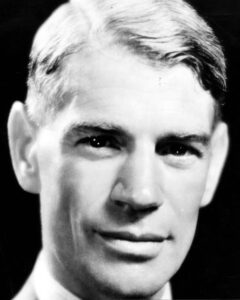
 James Whale was born in Dudley, England, a poor mining town, in 1889. He learned to direct as a prisoner of war in a German prison camp during World War I. That experience led him to the London stage, Broadway and eventually a Hollywood contract with Universal, where he made most of his films.
Although it was a war film, the screen version of his acclaimed stage success, Journey’s End, that brought him to Hollywood, it was his work in horror films that gave him his greatest reputation.
Combining humor and compassion for his characters with dollops of horror, Whale’s horror films beginning with 1931’s Frankenstein and extending through 1933’s The Invisible Man and 1935’s The Bride of Frankenstein were among the most popular entertainments of their time and continue to win new fans with each succeeding generation. Part of their success was due to the impeccable casting which was all Whale’s doing. It was he who saw something in British character actor Boris Karloff that moved him to cast the actor in his star-making role as the monster in Frankenstein. In addition to Karloff, Whale also gave career defining roles to Una O’Connor, Dwight Frye, Mae Clarke and Gloria Stuart in his first films.
Whale’s The Invisible Man received a Special Recommendation at the 1934 Venice Film Festival.
Despite his great success with the genre, Whale soon grew tired of being boxed in as a director of only horror films. His greatest achievement aside from his horror films was 1936’s Show Boat, the second of three versions of the Jerome Kern-Oscar Hammerstein II musical, film and by far the best. It was nominated for the Mussolini Cup for Best Foreign Film at the 1936 Venice Film Festival.
His next film, however, 1937’s The Road Back, a sequel to All Quiet on the Western Front, was a critical and commercial failure, largely due to studio interference. His subsequent films were not successful, and he made his last released film in 1941. He later directed a short film in 1950 which was never commercially released.
Whale’s last days were chronicled in the 1998 film, Gods and Monsters, which ironically won an Oscar (for Best Screenplay), an award Whale himself was never even nominated for.
While certainly a compelling film, it is nevertheless a work of fiction. The openly gay Whale had lived since the early 1930s with his life partner, producer David Lewis, who is not a character in the film. It was Lewis who found Whale’s body floating in the pool in 1957 and suppressed his suicide note until near the end of his own life in 1987. For the thirty years between, Whale’s death had been an unsolved mystery.
He was 67.
ESSENTIAL FILMS
JOURNEY’S END (1930)
Colin Clive, David Manners and Ian MacLaren starred in the film version of Whale’s acclaimed anti-war play about claustrophobia in the trenches and the toll it takes on men’s souls. Clive is the brusque, alcoholic Capt. Stanhope, Manners the impressionable Lt. Raeligh and MacLaren the sensitive Osborne. Billy Bevan and Anthony Bushell also turn in memorable performances in the film that was overshadowed by an even more impressionable anti-war film, Lewis Milestone’s All Quiet on the Western Front and Howard Hughes’ spectacular Hell’s Angels for which the Whale and Edmund Goulding provided much of the direction Hughes took credit for.
FRANKENSTEIN (1931)
Whale became the go-to director of horror films with his first foray into the genre, this exquisite version of Mary Shelley’s acclaimed novel about the obsessed scientist and the man he brings to life from assorted body parts of various dead people. Colin Clive was the mad Dr. Frankenstein. Mae Clarke was his wife, and Boris Karloff was the monster. One of the film’s key scenes, the one in which the monster accidentally drowns the little girl was excised by the censors after the Hollywood Production Code went into practice in 1934 and was not restored until home video editions of the film in the 1980s.
THE INVISIBLE MAN (1933)
Another movie milestone, The Invisible Man was quite faithful to the H.G. Wells novel on which it was based. Claude Rains made his talkie debut as the mad scientist title character only after Boris Karloff turned down the role, protesting that his face would be shown only at the end. Co-star Gloria Stuart famously complained that veteran stage actor Rains did his best to upstage her even though he was invisible! Character actress Una O’Connor all but stole the film as the screaming landlady who has her suspicions. The film was honored with a Special Recommendation at the 1935 Venice Film Festival.
THE BRIDE OF FRANKENSTEIN (1935)
Whale agreed to direct the sequel to his 1931 monster hit only if he were given complete artistic control. He was, and the result was that rare sequel that is even better than the original. Colin Clive and Boris Karloff were back as the mad scientist and his creation, with Valerie Hobson replacing Mae Clarke as his wife. Ernest Thesiger as Dr. Pretorious, O.P. Heggie and Una O’Connor as a screaming maid provide marvelous support, and Elsa Lanchester made film history in the dual role of author Mary Shelley in the film’s introductory scene and as the bride, not of Dr, Frankenstein, but of his monster.
SHOW BOAT (1936)
Whale cast the definitive version of the musical film with performers who had previously played their roles on stage. Charles Winninger, Paul Robeson, and Helen Morgan were from the original production, while Irene Dunne starred in the first touring version and Allan Jones and Hattie McDaniel played their parts in Los Angeles. Dunne was the only one reluctant to recreate her role, primarily because she didn’t think Whale could do justice to the material. He proved her wrong, especially in the shuffle dance she does with Morgan, McDaniel, and Robeson and in the counter-duet, “I Have the Room Above Her” with Jones.
JAMES WHALE AND OSCAR
No nominations, no wins.