

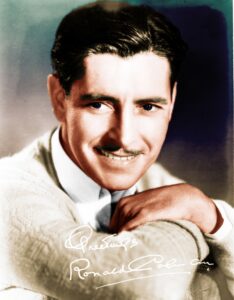
 Born February 9, 1891 in Richmond, Surrey, England, Ronald Colman made his professional acting debut in 1914. An ankle injury in World War I left him with a slight limp which he tried to hide for the rest of his life.
In America from 1920 on, “the longer he stayed”, opined Douglas Fairbanks, Jr., “the more English he got, but he never wanted to go home.”
Although he had been in films before, the start of his legendary screen career really began with 1923’s The White Sister in which he played the dashing hero opposite Lillian Gish. That film, as well as such later hits as The Dark Angel, Stella Dallas, Lady Windemere’s Fan, and Beau Geste were remade as talkies with other actors but not even a Clark Gable in The White Sister or a Gary Cooper in Beau Geste could compare with Colman in the original.
His voice, which was described as “beautifully modulated and controlled” made his transition to talkies seem effortless. He was nominated for an Oscar as Best Actor of 1929/30 at the third Academy Awards for his performances in two films, Bulldog Drummond in which he played the classic detective and Condemned in which he played a convict who has an affair with the warden’s wife played by Ann Harding.
Hit after hit followed, including Arrowsmith opposite Helen Hayes, Clive of India opposite Loretta Young, A Tale of Two Cities opposite Elizabeth Allan, Under Two Flags opposite Claudette Colbert, Lost Horizon opposite Jane Wyatt;,The Prisoner of Zenda opposite Madeleine Carroll, If I Were King opposite Frances Dee, and The Light That Failed opposite Ida Lupino.
Divorced from his first wife in 1934, Colman married actress Benita Hume, fifteen years his junior, in 1938.
After a couple of critical and box office duds, Colman returned to the top of his game opposite Cary Grant and Jean Arthur in 1942’s The Talk of the Town and then had the biggest hit of his career opposite Greer Garson that same year in Random Harvest, for which he received his second Oscar nomination.
1944’s Kismet opposite Marlene Dietrich was not a success, after which he became very choosey about the films he made, making only three more before going onto television. He appeared in two in 1947, The Late George Apley and A Double Life, finally winning an Oscar for the latter. 1950’s Champagne for Caesar gave him the rare opportunity to display his comedic talents on screen.
He and Hume starred in the 1954-55 TV comedy series, The Halls of Ivy, after which he returned to films in a cameo in 1956’s Around the World in 80 Days and as The Spirit of Man opposite Vincent Price in 1957’s truly bizarre The Story of Mankind.
Ronald Colman died of a lung infection May 19, 1958 at the age of 67. Less than a year later his widow became George Sanders’ third of four wives, but the only one to have been married to him until her death. She died of cancer in 1967 at 61.
ESSENTIAL FILMS
CONDEMNED (1929), directed by Wesley Ruggles
Colman received Oscar nods for both Bulldog Drummond and Condemned at the 1929/30 awards. A third Colman film, Raffles, was nominated for Best Sound. Condemned, in which he played a suave thief as he would in the later Raffles, is not as well known as Bulldog Drummond in which he played the famed fictional detective, but it is the better film. Set in the infamous French penal colony on Devil’s Island, Colman’s polished prisoner is chosen to act as a servant in the home of sadistic warden Dudley Nichols where he falls in love with Ann Harding as the warden’s unhappy wife. Louis Wolheim plays a fellow prisoner. All four actors are terrific.
A TALE OF TWO CITIES (1935), directed by Jack Conway
Colman’s mellifluous speaking voice was never put to better use than as the tragic Sydney Carton in this most celebrated of the film versions of Charles Dickens’ classic novel of the French Revolution. Caught in the throes of the times, he makes the ultimate sacrifice for the woman he loves by taking her innocent husband’s place at the guillotine. The marvelous supporting cast includes Elizabeth Allan, Edna May Oliver, Basil Rathbone and Blanche Yurka, all of whom deliver unforgettable performances, but Colman’s tops them all: “It’s a far, far better thing I do than I have ever done. It’s a far, far better rest I go to than I have ever known.”
LOST HORIZON (1937), directed by Frank Capra
Colman gave another indelible performance in the first film version of James Hilton’s beloved novel as Robert Conway, who along with other survivors of a plane crash, comes to the enchanted land of Shangri-La and ends up their leader. Under Capra’s sublime direction, the mystical novel comes to life with Colman the perfect actor to embody the everyman who is chosen by the 200- year-old High Lama, played by Sam Jaffe, to be his successor. Jane Wyatt, John Howard, Thomas Mitchell, Edward Everett Horton, Oscar nominated H.B. Warner, Isabel Jewell, and Margo co-star. Colman also had a major triumph in a dual role in the same year’s The Prisoner of Zenda.
RANDOM HARVEST (1942), directed by Mervyn LeRoy
At 51, Colman could still get away with playing romantic leads, and he was quite convincing as the World War I veteran amnesiac who falls in love with Greer Garson twice in James Hilton’s romantic classic. While Colman and Garson make a realistic couple, it takes a bit of a stretch to accept that twenty-year-old Susan Peters would also be in love with Colman, but the young actress made a strong enough impression, securing an Oscar nomination for Best Supporting Actress while Colman was nominated for Best Actor. Garson, of course, won the year’s Best Actress award for that year’s other blockbuster, Mrs. Miniver.
A DOUBLE LIFE (1947), directed by George Cukor
Colman proved he still had what it took to command the box office with his Boston Brahmin earlier in the year in the film version of John P. Marquand’s The Late George Apley, but outdid himself as the mad actor who confuses his stage role as Othello with reality in Oscar nominees Ruth Gordon and Garson Kanin deftly penned A Double Life. Colman’s Oscar winning performance may not be as grand as his earlier work, but he is convincing, particularly in the scenes in which he murders Shelley Winters in her star-making turn, and almost murders his ex-wife Signe Hasso, who his stage Desdemona.
RONALD COLMAN AND OSCAR
Bulldog Drummond/Condemned (1929/30) – nominated – Best Actor
Random Harvest (1942) – nominated – Best Actor
A Double Life (1947) – Oscar – Best Actor