

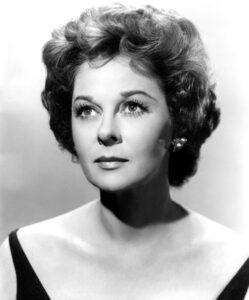
 Born Edythe Marrener, the daughter of a transportation worker, in the Flatbush section of Brooklyn, N.Y. on June 30, 1917, the future Susan Hayward went to the movies a lot as a child to escape the boredom of her poor surroundings. A stunning beauty even as a child, she became a photographer’s model as a teenager and was one of many who went to Hollywood in 1937 to audition for the part of Scarlett O’Hara in Gone with the Wind leading to several uncredited appearances in films beginning with 1937’s Hollywood Hotel. Her first credited role was in 1938’s Girls on Probation.
Hayward had prominent roles in 1939’s Beau Geste and 1940’s Adam Had Four Sons, but it was as the femme fatale in 1941’s Among the Living that she made the critics sit up and take notice. Given major roles in such films as 1942’s Reap the Wild Wind and I Married a Witch and 1944’s The Fighting Seabees; The Hairy Ape and And Now Tomorrow, the busy actress took time out of her career to marry actor Jess Barker in 1944 and give birth to fraternal twins in 1945.
Returning to the screen in 1946, she had memorable roles in 1947’s The Lost Moment and Smash-Up: The Story of a Woman, earning an Oscar nomination for the latter in which she played an alcoholic singer who sacrifices her career for her husband’s. The role was allegedly based on Bing Crosby’s first wife, Dixie Lee.
Hayward’s Oscar nomination for Smash-Up may have been considered a fluke but when she received a second one for playing another alcoholic in 1949’s My Foolish Heart, she was given her pick of projects and chose them wisely.
The 1950s was a tumultuous decade for the actress. She attempted suicide during the contentious divorce proceedings with Barker in 1954; happily married a Georgia farmer in 1957 and earned an additional three Oscar nominations for 1952’s With a Song in My Heart; 1955’s I’ll Cry Tomorrow and 1958’s I Want to Live!, finally winning for the latter. Other hit films within the decade included 1951’s David and Bathsheba; 1952’s The Snows of Kilimanjaro and The Lusty Men, 1953’s The President’s Lady. 1954’s Demetrius and the Gladiators and Garden of Evil, 1955’s Untamed and Soldier of Fortune, 1957’s Top Secret Affair, and 1959’s Woman Obsessed.
The 1960s found a less productive but still potent star at work in such films as 1961’s Marriage-Go-Round, Ada, and Back Street, 1962’s I Thank a Fool, 1963’s Stolen Hours, 1964’s Where Love Has Gone, and 1967’s The Honey Pot and Valley of the Dolls.
A couple of TV movies and one film, 1972’s The Revengers made up her entire output in the early 1970s. Diagnosed with a brain tumor in 1973, Hayward made a gallant appearance at the 1973 Oscars accompanied by Charlton Heston, her co-star in The President’s Lady to present the award for Best Actress to Glenda Jackson for A Touch of Class in early 1974. It was her last public appearance.
Susan Hayward died on March 14, 1975. She was just 57 years old.
ESSENTIAL FILMS
WITH A SONG IN MY HEART (1952), directed by Walter Lang
Compared at the time to James Cagney’s great Oscar winning performance as George M. Cohan in Yankee Doodle Dandy ten years earlier, Hayward’s portrayal of mid-Twentieth Century singing legend Jane Froman earned her a Golden Globe as well as her third Oscar nomination for Best Actress. Hayward’s lip synching to Froman’s warbling of some of the greatest songs of the period is movie magic at its best. With a supporting cast that included David Wayne, Rory Calhoun, Robert Wagner and Thelma Ritter, who also received her third Oscar nomination as her caregiver, it was one of Hayward’s biggest box office hits.
I’LL CRY TOMORROW (1955), directed by Daniel Mann
Hayward played her third singer after Smash-Up: The Story of a Woman and With a Song in My Heart and her third alcoholic after Smash-Up and My Foolish Heart. It was no surprise that she was nominated for an Oscar for the fourth time as legendary singer/actress Lillian Roth. Though ably supported by Richard Conte; Eddie Albert; Jo Van Fleet and Ray Danton among others, the film is almost all Hayward all the time in one of her greatest roles. Jo Van Fleet who played Hayward’s controlling mother took home the year’s Best Supporting Actress Oscar as an even more rotten mother in East of Eden.
I WANT TO LIVE! (1958), directed by Robert Wise
Having lost four Oscar races, Hayward wondered if she would ever win. She didn’t have to wonder for long. Her portrayal of Barbara Graham, the convicted murderer whose gas chamber execution is vividly and harrowingly portrayed in the film, was pure Oscar bait. You can’t take your eyes off her. The film itself made as a plea against capital punishment, positing the theory that Graham may have been an innocent companion of the two men who were convicted with her. The film suggests that she was convicted because of her lifestyle, that of an errant mother, prostitute and drug addict.
WHERE LOVE HAS GONE (1964), directed by Edward Dymtryk
A box office hit based on the notoriety of the film’s theme – it was based on the Johnny Stompanato murder by Lana Turner’s daughter – and the battle royale of the film’s star divas, Hayward in the Turner role and Bette Davis as her mother. Davis had been miffed at Hayward for remaking one of her classic films, 1939’s Dark Victory as The Stolen Hours the year before. Their battles while filming were well reported by the Hollywood gossips of the day – Louella Parsons, Hedda Hopper and others. Davis had insisted on so many script changes that Hayward finally put her foot down and insisted that further filming adhere to the script as written.
VALLEY OF THE DOLLS (1967), directed by Mark Robson
In what would be her last successful film at the box-office, Hayward, who replaced Judy Garland in the role of a has-been singer, gives the ludicrous film from Jaqueline Susann’s bestseller what little class it has. In one of the film’s most bizarre scenes, a temperamental Patty Duke pulls off Hayward’s wig and throws it in the toilet to thoroughly humiliate her. It was an ignoble end to one of Hollywood’s most stellar careers. Duke, a gifted Oscar winner herself as the young Helen Keller The Miracle Worker five years earlier, gives a horrid performance in her first adult role. The performances of co-stars Barbara Parkins and Sharon Tate aren’t much better.
SUSAN HAYWARD AND OSCAR
Smash-Up: The Story of a Woman (1947) – nominated – Best Actress
My Foolish Heart (1949) – nominated – Best Actress
With a Song in My Heart (1952) – nominated – Best Actress
I’ll Cry Tomorrow (1955) – nominated – Best Actress
I Want to Live! (1958) – Oscar – Best Actress