

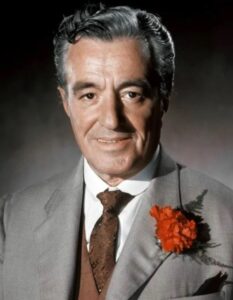
 Born July 7, 1901 in Lazio, Italy, Vittorio De Sica grew up in Sicily where his first job was as an office clerk in support of his poor family. Drawn to acting, he made his film debut as the title character as a boy in The Clemenceau Affair in 1917. He did not make another film for ten years, becoming in the interim one of Italy’s most popular matinee idols on stage.
De Sica married actress Giuditta Rissone in 1937 with whom he had a daughter. She was also his business partner with whom he produced and directed comedies for the stage in the late 1930s. He became a film director in 1940 while still acting. On the set of a film in 1942, he met Spanish actress Maria Mercader who was the sister of Trotsky’s assassin, Ramon Mercader. From then on, he kept up a double life, married to Rissone but living with Mercader with the full knowledge and approval of the two women. On Christmas and New Year’s, he would celebrate the holidays with Rissone and their daughter at Rissone’s home and then celebrate all over again with Mercader and their eventual two sons at the home he shared with her. He was not able to divorce Rissone until 1954. His marriage to Mercader in France in 1959 was not recognized in Italy.
De Sica was a gambler all his life. Although his fame as a director would eclipse his fame as an actor, De Sica kept up a steady career as an actor so he could maintain his gambling habit as well as the cost of his two households. His most famous role as an actor was in David O. Selznick’s 1957 production of A Farewell to Arms for which he received an Oscar nomination for Best Supporting Actor. Other roles of note as an actor were in such films as 1960’s It Started in Naples and The Millionairess and 1968’s The Shoes of the Fisherman and If It’s Tuesday, This Must Be Belgium.
Although he started out as a director of light comedies, De Sica made his reputation as a director with his neorealist social commentary films beginning with 1944’s The Children Are Among Us. 1946’s Shoeshine and 1948’s Bicycle Thieves. Both received special foreign film awards at the Oscars before foreign films were given their regular award. They both received nominations for their screenplays as well. 1952’s Umberto D. was also nominated for an Oscar for its screenplay. 1954’s Gold of Naples was his first film with Sophia Loren who he would direct to an Oscar in 1960’s Two Women. 1963’s Yesterday, Today and Tomorrow, starring Loren opposite Marcello Mastroianni, would win the Oscar for Best Foreign Language Film and 1964’s Marriage Italian Style, again starring Loren and Mastroianni, would be nominated in that category. 1971’s The Garden of the Finzi-Continis would become De Sica’s second film to win a Foreign Film Oscar in competition and his fourth overall.
De Sica’s last two films, 1973’s A Brief Vacation and 1974’s The Voyage were both released in the U.S. after his death, A Brief Vacation in 1975 and The Voyage in 1977.
Vittorio De Sica died in Paris after the removal of a cyst from his lungs on November 13, 1974. He was 73.
ESSENTIAL FILMS
SHOESHINE (1946), directed by Vittorio De Sica
Roberto Rossellini’s Rome Open City released in Italy in 1945 and the rest of the world in 1946 was Italy’s first neorealist film. It was a huge success in its home country then and the rest of the world the following year. By 1946, Italy was engrossed by Hollywood films and had no appetite for de Sica’s brilliant Shoeshine about two street kids who ran afoul of postwar Rome and ended up in prison where the two friends eventually became enemies due to circumstances beyond their control. Filmed with a mix of professional actors and a host of unprofessional ones that de Sica taught to act, the film was an international success earning Italy’s first Oscar in early 1948.
BICYCLE THIEVES (1948), directed by Vittorio De Sica
An even more successful post-war neorealistic film than either de Sica’s Shoeshine or Rossellini’s 1947 film, Paisan, this one was a success in Italy as well as the rest of the world, earning Italy a second Oscar in early 1950. Both films paired trained actors with unprofessional ones to great effect. Although the film is quite somber, nobody dies in this one, which was what made this one more palatable at home. Originally released in the U.S. as The Bicycle Thief. It eventually came to be known by international title which gave a more universal flavor to the title character who was not the only one who stole someone else’s bicycle to make a living.
TWO WOMEN (1960), directed by Vittorio De Sica
Anna Magnani was originally supposed to play the mother of an adolescent girl in a Hollywood version of this war film set in 1943. Hollywood wanted to make it with Sophia Loren as the daughter, but Magnani balked at the casting, and the project was dropped. De Sica then planned to make it in Italian with Magnani, but when she had to withdraw due to illness, she suggested Loren for the part of the mother. Loren accepted, and 12-year-old Eleanora Brown was cast as the daughter. Released in Italy in December 1960, it was released in the rest of the world in 1961 earning Loren the first acting Oscar given for a foreign language performance.
THE GARDEN OF THE FINZI-CONTINIS (1970), directed by Vittorio De Sica
Following Shoeshine, Bicycle Thieves and Yesterday and Tomorrow, this became the fourth de Sica film to win an Oscar for Best Foreign Film. Set in Mussolini’s Italy in the late 1930s, this idyllic study of a well-to-do Italian Jewish family in its days before the forces of evil close in was De Sica’s first hit since 1964’s Marriage Italian Style. Released in Israel and Italy in December 1970, it was released in the rest of the world in 1971. Dominique Sanda, Lino Capolicchio, Fabio Testi and Helmut Berger were among the beautiful young people.
SHOESHINE 70 (2016), directed by Mimmo Verdesca
This documentary of the making of Shoeshine for its 70th anniversary opens with Rinaldo Smordoni who played Giuseppe, one of the film’s two 12-year-old star getting out of a car in front the exterior of the prison where the film took place and ends with the then 83-year-old former actor being given the film’s Oscar to hold by the grandson of the film’s producer. Smordoni and Franco Interlenghi who played the other starring role of Pasquale were interviewed separately. Smordoni who made just two more films as a child, became a bus driver while Interlenghi’s had a long career as both an actor and a writer, dying in 2016 at 83. Smordoni died in 2024 at 91.
VITORIO DE SICA AND OSCAR
A Farewell to Arms (1957) – nominated – Best Supporting Actor